
Rosin, live resin, diamonds and hash are all cannabis extracts under Canadian law. Here is what each term means, how to read the label and how they count.
Rosin, live resin, diamonds and hash are all cannabis extracts under Canadian law, and they are among the highest-THC products on any legal menu in Ontario. Every container is capped at 1,000 mg of THC, the label shows Total THC in mg per gram, and Health Canada advises that new or occasional consumers avoid high-concentration extracts.
Below: what the legal category covers, what each format name means, how to read the label, and how concentrates count toward the possession limit.
The legal category: cannabis extracts
In the federal Cannabis Regulations, concentrates fall under the cannabis extract class. That covers solvent-based products and mechanical ones alike: Health Canada's tracking system guidance treats kief sold on its own as an inhaled extract, and states that mechanically extracting trichomes to produce kief or hash is extraction.
Rules that apply to every concentrate on our shelves, according to Health Canada's composition requirements:
- No more than 1,000 mg of THC per immediate container.
- No sugars, sweeteners or colouring agents.
- Flavouring agents are permitted in extracts intended for inhalation, but packaging cannot suggest certain flavours other than the flavour of cannabis.
Separately, the regulations define a cannabis concentrate as a substance with more than 3% THC by weight. That definition matters for the possession limit, covered below.
How strong are concentrates?
Health Canada's About cannabis page gives a sense of scale:
| Product type | THC, up to |
|---|---|
| Fresh or dried herbal material | 30% |
| Physically concentrated extracts, such as hash and kief | 60% |
| Chemically concentrated extracts, such as hash oil, shatter, budder and wax | 90% |
Health Canada's lower your risks guidance says certain extracts like hash, kief, wax or shatter contain a high concentration of THC, that higher amounts of THC can cause greater levels of impairment, and that new or occasional users should avoid them.
The formats, in plain language
The names below are industry terms, not legal categories. The label's product class will say "cannabis extract" for all of them.
Hash
Hash is made from the resin glands (trichomes) of the cannabis plant, collected and pressed together. Health Canada counts it among the physically concentrated extracts, at up to 60% THC.
Rosin
Rosin is an extract pressed out of flower or hash using heat and pressure rather than a chemical solvent. Producers often describe it as "solventless" for that reason. Check the label for the Total THC and the ingredients list.
Live resin
Live resin is an extract made from cannabis that was frozen soon after harvest instead of being dried and cured first. Producers use the term to signal that the starting material was fresh.
Diamonds
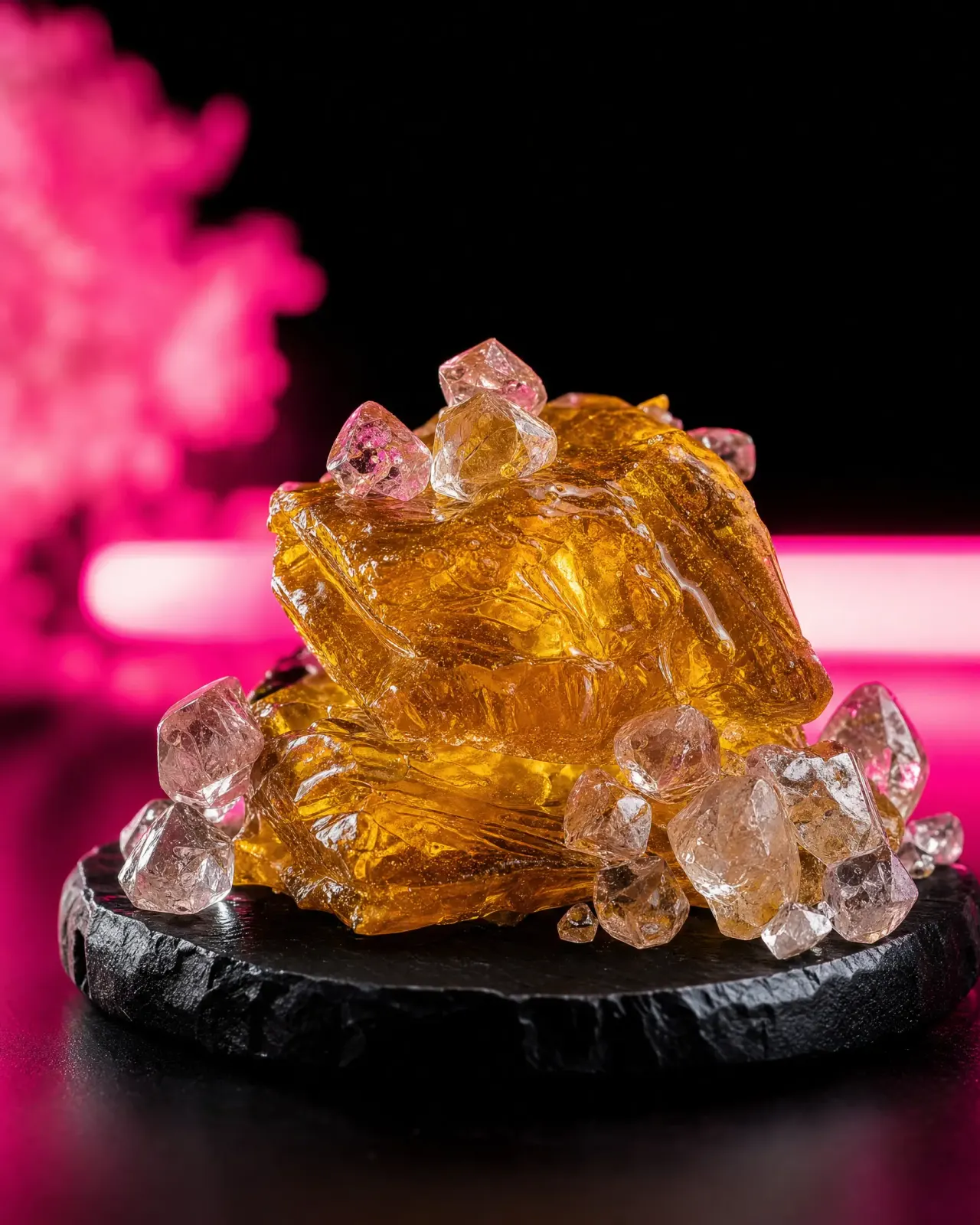
Diamonds are crystalline extracts, often sold together with a more liquid, aromatic extract sometimes called sauce. As with every concentrate, read the Total THC figure carefully.
How to read a concentrate label
Extracts that are not in units show:
- The net weight of extract, in grams.
- Total THC and Total CBD, in mg per gram.
- The ingredients list and any food allergens.
- The intended use.
- The standardized cannabis symbol, a health warning, the excise stamp, the lot number and the packaging date.
Do the math with the cap in mind. Total THC in a container is the mg/g figure multiplied by the net weight, and that total cannot exceed 1,000 mg. At 800 mg/g, for example, a single container can hold no more than 1.25 g of extract. To convert mg/g to a percentage, divide by 10. Our full cannabis label guide covers every panel.
Questions to ask before you buy a concentrate
- What is the Total THC in mg/g, and what is the net weight?
- What is the product class and the intended use on the label?
- What is listed in the ingredients, and are there any food allergens?
- What is the packaging date?
- Does this format need a particular device, and do I already have one that suits it?
Staff can answer all of these from the package and the menu listing, and none of them depends on a brand's marketing.
Concentrates and the possession limit
Under Schedule 3 of the Cannabis Act, 0.25 g of cannabis concentrate counts as 1 g of dried cannabis. Ontario's 30 g public possession limit therefore equals 7.5 g of concentrate. The AGCO also limits purchases to 30 grams of dried cannabis, or the equivalent, at one time. See our possession limits guide for how mixed purchases add up.
Lower your risks
- Concentrates are not a first-time product. If you are new, Health Canada suggests starting with inhaled products at 10% (100 mg/g) THC or less, and concentrates sit far above that.
- Inhaled effects are felt within seconds to minutes and can take up to 30 minutes to fully arrive, so wait before taking more.
- Avoid combining cannabis with alcohol, and never drive after using it.
- Store concentrates in their original child-resistant packaging, out of sight and reach of children and pets.
Shopping concentrates at Sugar Beach Cannabis
Extracts and concentrates have their own category on our live menu, covering rosin, live resin, diamonds and hash, each with Total THC, Total CBD, net weight, a regular price and a lower member price. If you prefer a concentrate in a vape, see 510-thread cartridge vs all-in-one. Staff help experienced buyers and first-timers alike, so ask about any product's label before you buy.
Visit Sugar Beach Cannabis
Sugar Beach Cannabis is at 192 Queens Quay East, Unit A5, Toronto, beside Sherbourne Common in East Bayfront. Browse the live menu, order online and pick up in store, or walk in with government photo ID (19+). Contact us with questions, or learn more about the store.
Frequently asked questions
Are concentrates legal in Ontario?
Yes. Rosin, live resin, diamonds and hash are sold legally in Ontario as cannabis extracts by licensed stores. Federal rules cap each container at 1,000 mg of THC.
How much concentrate can I carry in Ontario?
Schedule 3 of the Cannabis Act counts 0.25 g of cannabis concentrate as 1 g of dried cannabis, so the 30 g public possession limit equals 7.5 g of concentrate.
What is the difference between rosin and live resin?
Rosin is pressed from flower or hash with heat and pressure rather than a chemical solvent. Live resin is made from cannabis frozen soon after harvest instead of being dried and cured. Both are classified as cannabis extracts.
Are concentrates a good choice for a first-time buyer?
Health Canada advises that new or occasional users avoid extracts with a high concentration of THC, such as hash, kief, wax or shatter, and suggests starting with inhaled products at 10% THC or less.
This article is general information about cannabis rules and products in Ontario, not legal or medical advice. Rules change: check the official sources linked above. Cannabis is for adults 19+. Never drive impaired.
Sources
- Cannabis Regulations (SOR/2018-144), Justice Laws Website
- Cannabis Tracking and Licensing System reporting guide: Frequent issues and solutions (Health Canada)
- Guide on composition requirements for cannabis products (Health Canada)
- About cannabis (Health Canada)
- Cannabis: lower your risks (Health Canada)
- Cannabis Act (S.C. 2018, c. 16), Schedule 3: Equivalent Amounts
- Frequently Asked Questions: Retail Store Operation (AGCO)
- Cannabis laws (Government of Ontario)
- How to read and understand a cannabis product label (Health Canada)