
THC and CBD are the two most common cannabinoids in cannabis. Here is what each one is, why labels say "Total", and how to read the units.
THC and CBD are the two most common cannabinoids in cannabis. THC is delta-9-tetrahydrocannabinol and CBD is cannabidiol, and every legal product sold in Ontario shows both on the front of the label as Total THC and Total CBD.
The key difference, in Health Canada's words: THC is "the main cannabinoid responsible for the intoxication", while CBD "doesn't produce a high or result in intoxication", although Health Canada adds that it can still have other effects on the body and brain. Everything else on this page is about how the two numbers are measured and printed, so you can compare any two products on the shelf.
What THC and CBD are
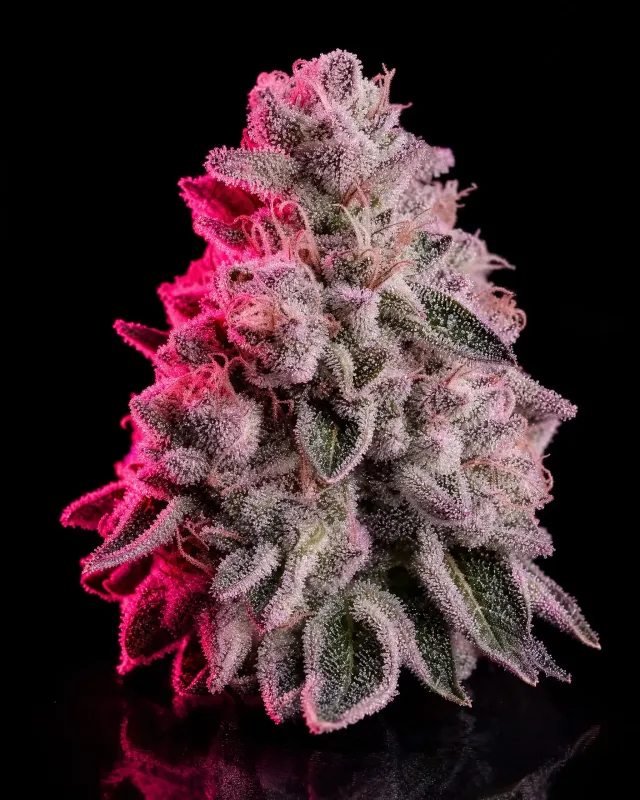
Health Canada's About cannabis page explains that cannabis contains hundreds of chemical substances, and over 100 of them are known as cannabinoids. They are made and stored in the trichomes, the tiny, clear hairs on the flowers and leaves of the plant.
The federal Cannabis Regulations define the names you see on the package:
- THC means delta-9-tetrahydrocannabinol.
- THCA means delta-9-tetrahydrocannabinolic acid.
- CBD means cannabidiol.
- CBDA means cannabidiolic acid.
THCA and CBDA are the acid forms found in the plant. They matter because of one word on the label: "Total".
Why the label says "Total"
The regulations require the THC figure to show what the product could yield, taking into account the potential to convert THCA into THC. They define that potential as the maximum amount of THC that would be obtained if THCA was converted into THC with no further degradation. CBD works the same way, with CBDA converting to CBD.
So "Total THC" is a ceiling: the most THC the product could contain if all its THCA converted. It is the figure every label must carry, which makes it the fairest number for comparing products.
One nuance from Health Canada's packaging and labelling guide: when a product contains THCA or CBDA and the way it is consumed will not convert it, such as an orally ingested oil, producers may add extra information to the label. If you see it, read it.
The units change by product type
A large number on a vape and a small number on a gummy are not measured the same way. This table follows the formats in Health Canada's labelling guide:
| Product | How Total THC and Total CBD appear |
|---|---|
| Dried flower and pre-rolls | mg/g |
| Vapes and other extracts for inhalation | mg/g |
| Oils with a dispenser | mg per activation |
| Capsules and other ingestible units | mg per unit |
| Edibles in pieces | mg per unit and mg per package |
| Edibles not in pieces, such as a drink | mg per package |
Health Canada's labelling guide also lists percentage of THC and CBD for dried cannabis as optional information, so some flower packages show a percentage beside the mg/g figure. It is not required.
How to read the numbers
From mg/g to a percentage. Divide by 10. Health Canada writes it as "10% (100 mg/g)" in its lower your risks guidance. So 180 mg/g is 18%, and 5 mg/g is 0.5%.
From mg/g to the whole package. Multiply by the net weight. A 3.5 g package of flower labelled Total THC 180 mg/g holds up to 630 mg of THC in total (180 x 3.5). That is our own example to show the maths, not a specific product.
Edibles. Read both lines. A package showing Total THC per unit 2.5 mg and Total THC 10 mg holds four pieces of 2.5 mg each. Our edibles guide covers the 10 mg per package limit.
The less-than sign. Some labels show "< 1 mg/g" or similar for a very low amount. Health Canada's guide says the less-than sign must not mislead consumers about a product's composition.
THC to CBD ratios
Some products are described by a ratio, such as 1:1 or 1:20. A ratio is just the two label numbers compared: a product with 10 mg/g Total THC and 10 mg/g Total CBD is 1:1. A product with 5 mg/g THC and 100 mg/g CBD is 1:20.
When you see a ratio on a menu, check it against the Total THC and Total CBD lines on the package, in the same units. The label is the figure the regulations require.
Health Canada's lower your risks guidance suggests choosing products with a low amount of THC and an equal or higher amount of CBD, and starting with inhaled products at 10% (100 mg/g) THC or less.
"High CBD" still means reading the THC line
Health Canada's consumer information page notes that CBD products can contain some amount of THC. So on a CBD-forward product, read the Total THC line as carefully as the CBD line.
A related clue is the red standardized cannabis symbol. Health Canada says it is required on the front of products with more than 10 micrograms of THC per gram. Our guide to how to read an Ontario cannabis label walks through the symbol, the excise stamp and the rest of the package.
What THC and CBD numbers do not tell you
Two products with similar Total THC can still differ in format, in terpene content and in how fresh they are. That is why we suggest comparing:
- Total THC and Total CBD, in the same unit.
- The format: flower, pre-roll, vape, edible, beverage, oil or concentrate.
- The packaging date.
- Terpene information, if the producer lists it. Our terpenes explainer covers how that appears.
Labels such as indica and sativa are not part of the required label. Our post on indica, sativa and hybrid explains why.
If you are thinking about cannabis for a medical reason, talk to a healthcare provider. Staff at the counter can explain labels and products, not give medical advice.
Shopping by the numbers at Sugar Beach
When you shop with us, staff can show you the Total THC and Total CBD on any package and help you compare two products in the same units. Every product on the menu has a regular price and a lower member price. Browse the live menu to see what is in stock, or read how ordering online for pickup works.
Visit Sugar Beach Cannabis
Sugar Beach Cannabis is at 192 Queens Quay East, Unit A5, Toronto, beside Sherbourne Common on the waterfront. Browse the live menu, order online and pick up in store, or walk in and ask staff to walk you through any label. We are open 10 a.m. to 10 p.m., 7 days a week (hours can change on holidays, so call ahead). 19+ with government photo ID. Contact us with questions, or read more about Sugar Beach Cannabis.
Frequently asked questions
What is the difference between THC and CBD?
Both are cannabinoids, the two most common in cannabis. Health Canada describes THC (delta-9-tetrahydrocannabinol) as the main cannabinoid responsible for intoxication, and says CBD (cannabidiol) does not produce a high or intoxication, although it can still have other effects on the body and brain.
What does Total THC mean on a label?
It is the amount of THC the product could yield, taking into account the potential to convert THCA into THC. The Cannabis Regulations require it on every label, so it is the best figure for comparing products. Total CBD works the same way for CBDA and CBD.
How do I convert mg/g to a THC or CBD percentage?
Divide by 10. Health Canada writes it as 10% (100 mg/g), so a label showing Total CBD 50 mg/g is 5% CBD.
Can a CBD product contain THC?
Yes. Health Canada notes that CBD products can contain some amount of THC, so always read the Total THC line on a CBD product as well as the Total CBD line.
What does a 1:1 THC to CBD ratio mean?
It means the product contains equal amounts of Total THC and Total CBD in the same unit, for example 10 mg/g of each. Check the ratio against the two numbers on the label.
This article is general information about cannabis rules and products in Ontario, not legal or medical advice. Rules change: check the official sources linked above. Cannabis is for adults 19+. Never drive impaired.
Sources
- About cannabis (Health Canada)
- How to read and understand a cannabis product label (Health Canada)
- Cannabis Regulations (SOR/2018-144), Justice Laws Website
- Packaging and labelling guide for cannabis products (Health Canada)
- Cannabis: lower your risks (Health Canada)
- Consumer information: Cannabis (Health Canada)